




Information
Dry cured sausage seasoning, classic flavour without a starter culture
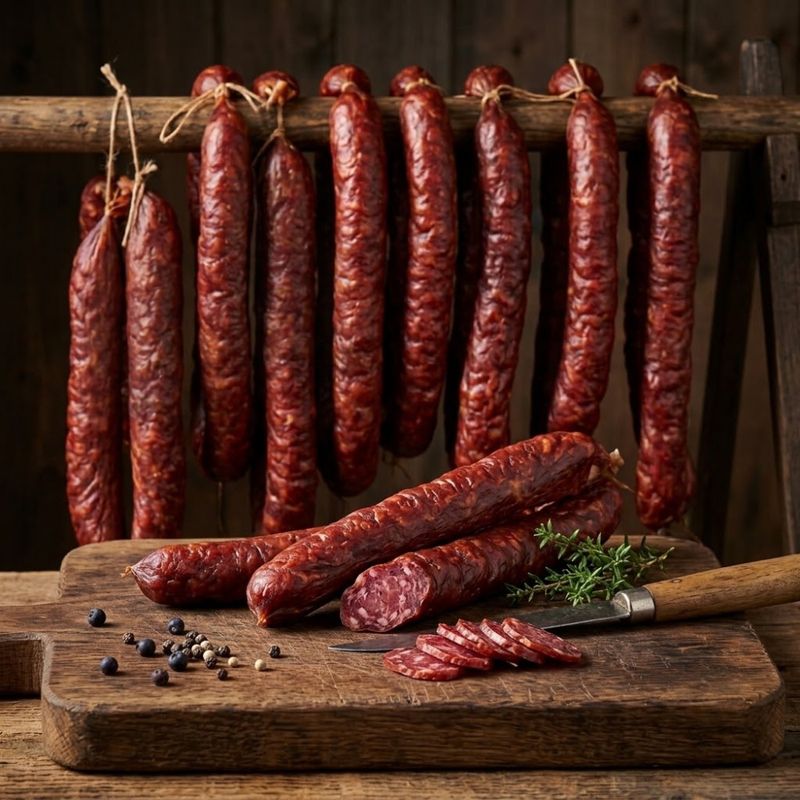
This is the base blend for dry cured sausage, the restrained version with pepper and garlic that lets the meat stay the main flavour. What sets it apart from an ordinary spice mix is the acidity regulator E575, glucono delta lactone, which lowers the pH chemically instead of through fermentation. You need neither a starter culture nor a fermentation chamber, and the acidification happens over hours instead of days. One 200 g bag is enough for 8 kg of sausage meat.
|
200 g for 8 kg of meat
|
Acidifies without a culture
|
|
Pepper and garlic
|
No declarable allergens
|
Be clear about what you get and what you do not. E575 gives you the acidity, meaning the fresh salami tang and the lower pH that makes the sausage safe to dry. What it does not give you is the aroma a living culture builds over several days. For your first dry cured sausage, or when you have nowhere to hold a stable fermentation temperature, that is a good trade: you get a predictable result without having to nurse bacteria. The blend contains maize starch and dextrose to bind and feed, and neither salt nor added phosphate, so the salting is entirely under your control.
Freeze the fat rock hard before grinding. Soft fat smears across the meat and seals the surface of each piece, so moisture cannot leave evenly during drying. The result is a sausage that is dry on the outside and still raw at the core. Cut the fat into cubes, freeze it until it rattles in the bowl, and grind it cold. That is exactly why the manufacturer specifies frozen fat in their own recipe.
The blend contains neither salt nor nitrite, so you supply both yourself. Dry cured sausage is made with nitrite salt 0.6 %, and the meat goes into a casing that can handle drying, for example fibrous casing 50 mm.
Features
- Acidifies without a culture: The acidity regulator E575 lowers the pH chemically. No starter culture, no fermentation chamber and no days of watching the temperature.
- Fast and predictable: Acidification happens over hours rather than days, and the result is the same from batch to batch.
- Classic seasoning: Pepper and garlic, the restrained profile that lets the raw material come through instead of drowning it.
- Binds and feeds: Maize starch and dextrose hold moisture in the mix and give a more even texture.
- No declarable allergens: None of the 14 allergens that must be declared under Norwegian and EU rules are present in the blend.
- No salt, no phosphate: 0 g salt and no added phosphate in the blend, so you set the salt level yourself from the recipe.
- Long shelf life: 24 months in the unopened foil bag, stored dry and out of direct sunlight.
How to use
- Cut the meat and the fat into cubes. Put the fat in the freezer until it is frozen through.
- Grind the meat and fat cold. Keep the equipment cold too, so the fat stays in separate grains instead of smearing.
- Mix 200 g of the blend, 270 g salt and 90 g nitrite salt into 4 kg of meat and 4 kg of frozen fat. 50 g of cognac or rum can be added if you like.
- Work the mix until it binds and turns tacky. That is what holds the pieces together and keeps voids out of the finished sausage.
- Stuff into casings without air pockets. Trapped air leaves grey patches and discolouration inside the sausage.
- Hang the sausages somewhere cool with moving air. Weigh them as you hang them, so you know exactly when they are done.
Dosage guide
| Per bag (200 g) | 4 kg meat and 4 kg frozen fat |
| Blend per kg of meat | 25 g |
| Salt per bag | 270 g |
| Nitrite salt 0.6 % per bag | 90 g |
| Cognac or rum | 50 g, optional |
| Gives in the finished mix | about 67 mg nitrite per kg of meat and fat |
| Dried and ready at | about 30 % weight loss from hanging weight |
Specifications
| Content | 200 g |
| Makes | 8 kg of sausage meat |
| Ingredients | Acidity regulator: E575, maize starch, spices (pepper), dextrose, garlic |
| Allergens | None of the 14 declarable allergens |
| Energy per 100 g | 938 kJ (224 kcal) |
| Fat per 100 g | 0.5 g, of which 0.2 g saturates |
| Carbohydrate per 100 g | 50.3 g, of which 13.7 g sugars |
| Fibre per 100 g | 4.0 g |
| Protein per 100 g | 1.9 g |
| Salt per 100 g | 0 g |
| Added phosphate | 0 |
| Shelf life | 24 months |
| Storage | Dry and out of direct sunlight |
| Packaging | Foil and PE bag |
FAQ Frequently asked questions
Do I need a starter culture as well?
No. The blend acidifies with E575, and that does the job. Nor is it meant to be combined: the acid from E575 arrives fast enough to give lactic acid bacteria a poorer start, and how much that matters depends on how much acid the blend delivers. Pick one method, so you know what you are getting.
What is the difference between E575 and a starter culture?
E575 is not an acid in itself. It is a lactone that hydrolyses into gluconic acid when it meets moisture, which is why the pH falls on its own within hours. A starter culture is live lactic acid bacteria that feed on sugar and produce acid over several days, building aroma along the way. E575 is faster and more predictable, a culture gives a more complex flavour. If you want to try the culture route, we sell pure GDL and starter cultures separately.
Why does the fat have to be frozen?
Because soft fat smears through the grinder instead of being cut into separate grains. The fat then coats the meat and seals moisture in, so the sausage dries unevenly. Frozen fat grinds cleanly and gives the clear pattern of white fat grains you want in the cut surface.
Do I have to use nitrite salt?
For dry cured sausage that is never heat treated, nitrite is the established protection against Clostridium botulinum, and it is also what gives the red colour and the characteristic cured flavour. The manufacturer recipe uses 90 g of nitrite salt per bag. We have written at length about the research and the regulations around nitrite in this article, which is written in Norwegian.
When is the sausage ready?
Expect around 30 per cent weight loss from the moment it was hung. Weigh the sausages as you hang them and write it down, so you are not guessing. A sausage weighing 1000 g at hanging is ready at around 700 g. Dry it too fast and you get a hard crust that seals the moisture inside.
Manufacturer

Foodstuff Collection
Product properties
| Krydder | Blandingskrydder |